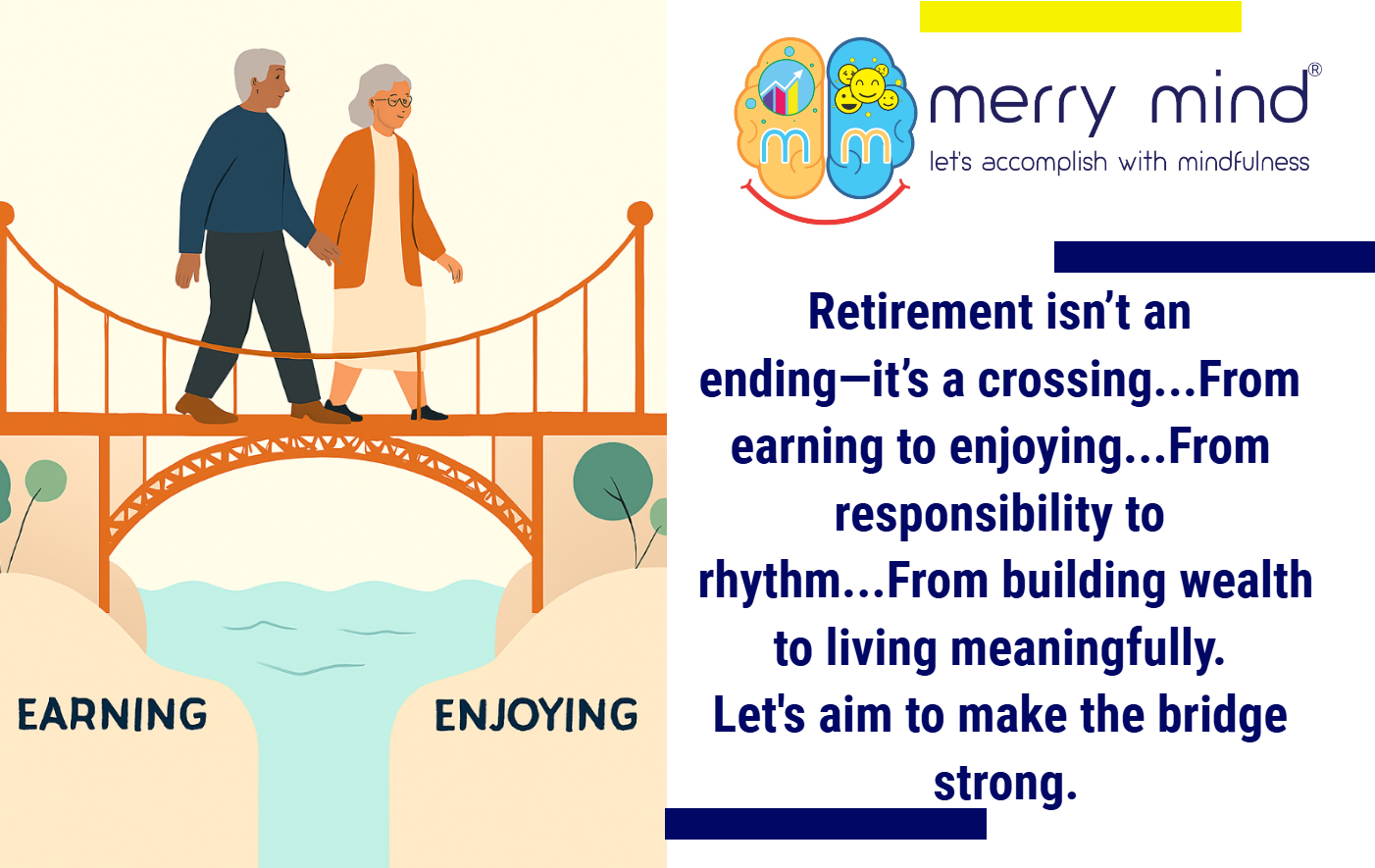

Retirement planning in India is the process of estimating future living expenses, building sufficient savings and investments, and arranging those assets to provide sustainable income after regular employment income stops. A well-designed retirement plan considers inflation, healthcare costs, life expectancy, taxes, existing retirement benefits, dependents and the lifestyle a person wishes to maintain.
Retirement is more than a financial milestone. It is a transition from earning and accumulating money to using accumulated wealth to support everyday life. Without a clear plan, retirees may face uncertainty about monthly expenses, unexpected medical costs and the possibility of outliving their savings.
A retirement plan therefore needs to address two connected dimensions: the technical aspects of money, such as cash flow, investments and risk, and the personal aspects, such as relationships, expectations, purpose and emotional well-being.
At Merry Mind, retirement planning is approached as an ongoing financial planning process that considers an individual’s circumstances, objectives and available resources. The aim is to develop a practical roadmap for the years before and after retirement.
What Is Retirement Planning?
Retirement planning involves estimating how much money may be required after active employment ends, determining the resources already available, calculating the potential funding gap and creating a strategy to address it.
The process typically includes:
- Defining retirement goals and the lifestyle you wish to maintain.
- Estimating current and future living expenses.
- Accounting for inflation and the potential length of retirement.
- Reviewing existing assets and retirement benefits.
- Estimating healthcare, insurance and emergency requirements.
- Assessing pension income and other dependable cash flows.
- Developing a suitable savings and investment strategy.
- Planning how retirement assets may be withdrawn and used.
- Reviewing the plan as circumstances change.
Retirement planning is not limited to people approaching the end of their careers. Starting earlier provides more time to build savings, review assumptions and make adjustments if the projected retirement corpus is insufficient.
Why Is Retirement Planning Important in India?
Many households cannot rely entirely on a universal, government-provided pension to cover all their retirement expenses. The level of support available varies by employment, pension eligibility, family circumstances and existing assets.
For many individuals, retirement income may come from a combination of employer retirement benefits, eligible pension arrangements, personal investments, deposits, rental income and other resources. The mix differs from one household to another.
Several factors make retirement planning important:
- Inflation: Living expenses may increase considerably between the present day and retirement.
- Longevity: Retirement savings may need to support a person for several decades.
- Healthcare: Medical expenses, insurance premiums and care requirements can change with age.
- Changing family responsibilities: Some people continue supporting a spouse, dependent parents or adult children.
- Loss of regular employment income: Monthly expenses may continue even when salary income stops.
- Taxation and investment risk: The amount available to spend depends on the structure of income, assets, withdrawals and applicable taxes.
- Lifestyle and personal goals: Travel, hobbies, relocation and family activities may affect the required retirement budget.
The objective is not simply to accumulate a large sum. It is to build a financial arrangement that can support the life you expect to lead.
What Should a Retirement Planner Consider?
Retirement planning is personal because two people with similar incomes may have very different financial needs.
A retirement plan should examine both the financial calculations and the individual’s expectations.
1. Retirement age and expected duration
The intended retirement age influences how long you have to accumulate assets. It also determines how many years your retirement resources may need to support you.
Consider the possibility of early retirement, a career break, voluntary retirement, delayed retirement or part-time work. The plan should be tested against different retirement dates rather than depending on a single assumption.
2. Expected lifestyle after retirement
Think about where you want to live, the activities you want to pursue and the responsibilities you expect to retain.
Some expenses may decline after retirement, such as work-related travel. Others may increase, including healthcare, leisure or support for family members.
Avoid assuming that retirement expenses will automatically be a fixed percentage of current income. Build an estimate from the lifestyle you actually expect.
3. Dependents and family responsibilities
List the people who may depend on your financial resources after retirement. Consider whether you expect to support a spouse, dependent parents or other family members, and whether significant planned expenses remain.
4. Existing assets and retirement benefits
Review the assets that may be available to fund retirement. Depending on eligibility and individual circumstances, these could include EPF, NPS, pension entitlements, PPF, deposits, mutual funds, other investments and income-producing assets.
Do not automatically count every asset as retirement money. A family home intended for continued personal use, funds reserved for another goal or an illiquid asset may not be readily available to pay retirement expenses.
5. Health, insurance and contingencies
Estimate regular healthcare expenses and review the suitability and limitations of existing health insurance. Consider premiums, waiting periods, exclusions, co-payments and the potential effect of medical costs on cash flow.
Insurance does not eliminate every financial risk. A retirement plan should also account for emergency savings and the possibility of expenses that are not fully covered.
6. Personal expectations and emotional transition
Retirement can change daily routines, relationships, professional identity and a person’s sense of purpose.
A useful plan asks questions beyond the financial calculations:
- How do you want to spend your time?
- Which activities or relationships will become more important?
- Are both partners aligned about retirement expectations?
- Would you prefer to stop working completely or continue in some capacity?
- What changes might be difficult to adjust to?
Understanding these questions helps connect the financial plan with the life it is intended to support.
How to Calculate Your Retirement Corpus
A retirement corpus is the pool of assets intended to fund expenses and financial goals during retirement. There is no single amount that is appropriate for everyone.
The required corpus depends on the estimated expenses, retirement date, expected duration of retirement, inflation, dependable income, investment assumptions, taxes and the risks the household needs to accommodate.
A practical starting process is as follows.
Step 1: Estimate your current annual expenses
Start with actual household spending rather than a general rule based on salary.
Separate expenses into categories such as:
- Housing and household maintenance.
- Food, utilities and daily living.
- Transport and travel.
- Healthcare and insurance.
- Family support and dependents.
- Loan repayments, if any.
- Leisure and personal interests.
- Annual or irregular expenses.
Then identify which expenses may continue, increase, decrease or disappear after retirement.
Step 2: Project expenses to the retirement date
Inflation reduces the purchasing power of money over time. An expense that seems manageable today may be considerably higher when retirement begins.
A simplified inflation projection is:
Future expense = Current expense × (1 + annual inflation rate)^number of years
For example, if annual expenses are ₹6 lakh today and inflation averages an assumed 6% a year for 20 years:
₹6,00,000 × (1.06)^20 ≈ ₹19.24 lakh a year.
This is an illustration, not an inflation forecast. Actual inflation can differ, and different expenses may rise at different rates. Healthcare costs, for example, may not follow the same pattern as general household spending.
Step 3: Estimate your retirement duration
Consider how long the retirement corpus may need to last. A plan for retirement at 55 may need to fund a longer period than a plan beginning at 65.
No one can know an individual’s lifespan in advance. It is therefore sensible to test the plan against a longer retirement period instead of assuming that the funds will only be needed for a short number of years.
Step 4: Identify dependable retirement income
List the income sources you reasonably expect to receive after retirement, such as an eligible pension, annuity income, rental income or other recurring receipts.
Assess the reliability, inflation sensitivity, taxation and conditions attached to each source. Do not treat uncertain future income as guaranteed.
Step 5: Estimate the funding gap
Compare projected retirement expenses with dependable income.
Annual funding gap = Estimated annual retirement expenses − Dependable annual retirement income
For example, suppose projected annual expenses are ₹18 lakh and dependable annual income is ₹6 lakh. The initial annual funding gap is ₹12 lakh.
This figure is a starting point, not the required corpus. The corpus calculation must also account for investment returns, inflation, withdrawal timing, taxes, irregular expenses and the possibility that income or expenses may change.
Step 6: Calculate and stress-test the required corpus
A retirement calculation should use a cash-flow projection rather than relying solely on a generic multiplier.
Estimate annual expenses and income across the expected retirement period. Apply explicit assumptions for inflation and investment returns, account for the timing of withdrawals, and estimate the amount of assets required at the retirement date.
Test more than one scenario:
- Higher-than-expected living costs.
- Lower investment returns.
- A longer retirement period.
- Unexpected healthcare expenses.
- Changes in pension or other income.
- Early retirement or a delayed start to saving.
A result that works only under optimistic assumptions may not provide enough resilience. A range of outcomes is more useful than a seemingly precise number based on uncertain inputs.
Why Inflation Matters in Retirement Planning
Inflation is one of the major factors affecting retirement readiness. Even when the amount of money in a bank account remains unchanged, the goods and services it can purchase may become more expensive over time.
Suppose an individual spends ₹50,000 a month today. At an assumed annual inflation rate of 6%, the equivalent monthly spending requirement after 20 years would be approximately ₹1.60 lakh.
The calculation illustrates why planning with today’s expenses alone can lead to an inadequate retirement estimate.
Investment returns should also be considered after allowing for inflation, relevant taxes and costs. A positive nominal return does not necessarily mean that purchasing power has increased by the same amount.
For example, if an investment earns a nominal return of 8% and inflation is 6%, the approximate real return before tax and costs is 1.9%, not 8%. The exact real return is calculated as:
Real return = (1 + nominal return) ÷ (1 + inflation rate) − 1
The assumptions used in a retirement plan should be reviewed periodically. Past returns and historical inflation do not guarantee future results.
Why Healthcare and Emergency Expenses Need Separate Attention
Healthcare planning is an important part of retirement readiness because expenses can vary significantly from one person to another.
Review existing insurance coverage and understand the policy terms. Consider premiums, deductibles or co-payments where applicable, exclusions, waiting periods and whether coverage is expected to remain available as circumstances change.
Also consider expenses that may arise from regular consultations, medication, caregiving, home modifications or other health-related needs.
A separate contingency reserve can help manage unexpected expenses without forcing immediate withdrawals from long-term investments during an unfavourable market period.
The amount required depends on the household’s health, insurance, essential expenses and available resources. It should be estimated as part of the overall plan rather than assumed to be the same for every retiree.
How to Plan Retirement Income and Withdrawals
Accumulating a retirement corpus and using it are two different challenges.
During working years, the main focus is often on saving and investing towards long-term goals. After retirement, the priority shifts towards managing withdrawals while preserving enough resources for future expenses.
A retirement income plan should consider the following.
1. Match assets to their intended purpose
Keep near-term spending requirements and emergency needs in assets suitable for their intended use. Longer-term investments may serve a different purpose and can carry different levels of risk.
The allocation should reflect the household’s cash-flow requirements, risk tolerance, ability to bear losses and expected retirement duration.
2. Avoid depending entirely on interest income
Interest-bearing products may contribute to retirement income, but the suitability of relying on them alone depends on their after-tax returns, inflation and the size of the corpus.
A strategy that does not account for inflation may gradually reduce the purchasing power of retirement savings. On the other hand, investments that carry market risk can also lose value.
The objective is to evaluate the combined role of income, liquidity, capital stability and long-term growth within the individual’s financial circumstances.
3. Establish a withdrawal process
Determine how regular expenses will be funded, which assets may be used first and how the plan will respond to market declines or unexpected costs.
Avoid assuming that a single withdrawal percentage is universally safe. The sustainability of withdrawals depends on the retirement period, asset allocation, investment returns, inflation, fees, taxes and the timing of market gains and losses.
4. Review withdrawals regularly
Compare actual spending and income with the plan. If expenses rise, returns disappoint or circumstances change, reassess the withdrawal amount and investment allocation.
A flexible plan can help identify the need for adjustments before a shortfall becomes difficult to manage.
Retirement Planning: Why Starting Early Helps
Starting early generally provides more time to accumulate savings and benefit from compounding, although investment returns are uncertain and not guaranteed.
Consider two hypothetical investors who plan to retire at age 60:
- Investor X starts at age 27 and invests ₹20,000 per month for 33 years.
- Investor Y starts at age 40 and invests ₹40,000 per month for 20 years.
Assume an illustrative annualised return of 10%, with monthly contributions and monthly compounding for the calculation. Under these assumptions, Investor X could accumulate approximately ₹6.23 crore, while Investor Y could accumulate approximately ₹3.06 crore.
These are hypothetical estimates, not assured outcomes. Actual values will depend on the timing of contributions, the returns earned, investment costs and other factors.
The example illustrates the potential benefit of a longer investment period. It does not mean that everyone should target a 10% return or use the same contribution amount. A suitable savings strategy should be based on the individual’s retirement target, available income, time horizon and capacity to accept investment risk.
If you are starting later, retirement planning can still be useful. You may need to review the target retirement age, savings rate, projected expenses and investment assumptions to understand the available options.
Common Retirement Planning Mistakes
Some common mistakes can make a retirement plan less reliable.
Ignoring inflation
Using today’s expenses without projecting future costs may result in an insufficient corpus.
Underestimating retirement duration
Planning for too few years can increase the risk of running short of funds later in life.
Overlooking healthcare and contingencies
Unexpected medical or caregiving expenses may place pressure on a plan that has no flexibility.
Relying on one return assumption
Assuming that investments will earn the same return every year can underestimate uncertainty, particularly when withdrawals coincide with market declines.
Depending entirely on one income source
A retirement plan should evaluate the reliability and limitations of each source of income and identify how expenses will be covered if one source changes.
Making emotional investment decisions
Market volatility, fear of losses or pressure from others can lead to decisions that are inconsistent with long-term objectives. Investment decisions should be assessed against the plan, risk profile and actual cash-flow requirements.
Forgetting taxes and liquidity
The amount available to spend may differ from the headline value of an asset or its stated return. Withdrawal conditions, tax treatment and access to funds need to be considered.
Treating retirement planning as a one-time exercise
Life events, market conditions, health, family responsibilities and financial regulations change. A plan should be reviewed and updated when assumptions no longer reflect reality.
What If You Want to Retire Early or Work Longer?
Not everyone follows the same retirement timeline. Some people consider voluntary retirement or an earlier exit from full-time employment, while others choose to continue working beyond their original target age.
Early retirement may require a larger corpus because savings must support a longer period and contributions may stop sooner. Delaying retirement can provide additional time to save and may reduce the number of years that assets need to fund, but the decision also depends on health, career prospects and personal priorities.
Before making a change, compare alternative scenarios using realistic assumptions for expenses, savings, investment returns and future income. Consider outstanding loans, dependents, insurance and the availability of liquid assets.
The purpose of this exercise is to understand the financial trade-offs and choices available—not to assume that one retirement age is ideal for everyone.
How a Financial Planner Can Help With Retirement Planning
Retirement planning involves interconnected decisions about lifestyle, cash flow, investments, insurance, taxation, risk management and estate planning.
A structured financial planning process may help you:
- Define retirement objectives and estimate future expenses.
- Evaluate existing assets and eligible retirement benefits.
- Estimate the potential retirement funding gap.
- Review savings and investment strategies against your goals and risk profile.
- Consider healthcare and emergency requirements.
- Plan for withdrawals and changes in income.
- Review relevant tax and estate-planning considerations.
- Monitor the plan and revise assumptions when circumstances change.
A financial planner should understand the client’s personal expectations as well as the technical calculations. This is especially important when retirement affects both partners, family responsibilities or a person’s sense of purpose.
Merry Mind’s approach to financial planning considers personal circumstances alongside the financial aspects of the plan. Learn more about personal financial planning and investment advice.
Frequently Asked Questions About Retirement Planning in India
How much money do I need to retire in India?
There is no single retirement corpus that works for everyone. The amount depends on your expected expenses, retirement age, duration of retirement, inflation, dependable income, existing assets, healthcare requirements and investment assumptions. Estimate your own retirement cash flows and test the plan under different scenarios.
When should I start retirement planning?
Starting as early as practical gives you more time to save and adjust your strategy. However, it is useful to assess retirement readiness at any age. If you begin later, review your retirement date, savings rate, expected expenses and other available options.
How does inflation affect retirement savings?
Inflation increases the cost of living over time and reduces the purchasing power of money. A retirement projection should estimate future expenses rather than assume that today’s monthly budget will remain unchanged.
Can I depend only on bank deposits or interest income after retirement?
That depends on the size of your assets, the income they generate after tax, inflation, liquidity needs and the length of retirement. Relying on one source without examining purchasing power and future expenses may create risks. Evaluate all income and investment sources as part of a broader plan.
How should I plan for healthcare expenses after retirement?
Review existing health insurance and understand its terms, limitations and costs. Estimate regular medical expenses and consider a separate contingency reserve for unexpected costs. The appropriate provision depends on your personal circumstances and available coverage.
How often should I review my retirement plan?
Review it periodically and whenever a major change occurs, such as a change in income, retirement age, health, family responsibilities, investment values or expected expenses. Compare actual results with the original assumptions and adjust the plan when necessary.
Conclusion: Retirement Planning Is an Ongoing Process
A retirement plan is not simply a target corpus or a list of investments. It is a financial roadmap designed to help you use your resources to support your desired lifestyle after regular employment income changes or stops.
Estimate expenses realistically, account for inflation and healthcare, assess dependable income, build a suitable investment strategy and prepare for withdrawals. Give equal attention to your personal expectations and the financial decisions needed to support them.
Most importantly, revisit your assumptions. Retirement planning is an ongoing process, not a one-time calculation.
To understand how your goals, current resources and future requirements fit together, explore personal financial planning with Merry Mind.
Disclaimer: This article is for general educational purposes only and does not constitute personalised financial, investment, tax or legal advice. Illustrative calculations are based on stated assumptions and do not guarantee investment returns or retirement outcomes. Individual circumstances differ; seek appropriately qualified professional advice where required.